Hello, Kids and All Readers,
Are you familiar with this quote?
“You have to write the book that wants to be written. And if the book will be too difficult for grown-ups, then you write it for children.” ~Madeleine L’Engle, author of A Wrinkle in Time Quintet
My interpretation of this famous quote is that children are better readers of truth than adults. In my opinion and experience, kids accept mystery, possibility, and emotional honesty better than adults. So, we writers of children’s literature should tackle big themes (love, courage, loss, good versus evil, etc.) without trepidation. These are too important to be constrained by adult expectations. We can explore them more freely since children do not avoid difficult truths or analyze them to death; they meet them with curiosity. Having taught kids for decades, I know that is true. So, I never underestimate children. Neither did Madeleine L’Engle. And she believed that the most profound truths are best communicated simply, clearly, and imaginatively.
As a children’s mystery author, I embrace L’Engle’s style. But here is the problem: I’m an adult. I have been complicating important themes for years now! So, the big question that stalks me with every word I write is, “How do I let go of my adultness and let the child within surface to craft a children’s book with simplicity, clarity, and imagination?” In other words, how do I uncomplicate the complicated? Well . . .
 Here, to date, is “The Joseph System” for doing that:
First, I remember what I learned as a teacher and from L’Engle: Adults often underestimate children. Kids are honest–often painfully so! They lack the self-consciousness that constrains adults. Kids have free-flowing imaginations that, sadly, too often disappear with adulthood. So, childhood is the perfect time to explore bold ideas! Kids like learning topics that their high school siblings are studying because it is cool. They’ve told me so. Or you can just read their happy facial expressions. And it bears repeating: I don’t underestimate children, ever. I also never talk down to them.
Second, I embrace higher-level vocabulary in my Middle Grade books (for kids ages 9 to 109). As a teacher, I “taught to the high,” then differentiated the curriculum to pull the others up. I apply this same technique when I write by building in supports for advanced vocabulary learning. Some of these supports include surrounding a word with context clues, following a “big word” with a bracketed [synonym of simple definition], and having our chief detective, Lanny the Lexicon, provide a vocabulary lesson. This isn’t as easy for me as it may seem, however. I must determine what words and ideas need support and when to back off and let the kids be conquering heroes.
Third, I try to make history come alive for children by showing them how it still influences what we do today: The Golden Age of Hollywood’s experimentation with color film and special effects over one hundred years ago; the glory of ancient Egypt and its culture; the many sides of Edgar Allan Poe; the amazing but underrated actor Boris Karloff; the teenage writer Mary Shelley, whose Frankenstein monster from 1816 is still undergoing iterations in the arts; Bass Reeves, one of the earliest and most innovative Black deputy U.S. marshals; the allure and truth about pirates; the wonders of geology; the bombing of Pearl Harbor and the horrific Japanese Internment Camps; and the Wild West days of Old California. Why not teach history through literature in a fun, relevant way while kids are still fascinated by it? Hence, my “mysteries with a twist of history”!
Fourth, I try my best to follow the Rules for writing Middle Grade literature, mainly to protect kids. I must avoid foul language, sex (innocent crushes are okay), drugs, and rock ‘n’ roll–okay, not the last one! And we must never place children in danger that can leave permanent physical or emotional scars. This is challenging in my mystery books since our four mature detective heroes are solving serious crimes. often in scary places. So, my strategies include using danger to teach when and how to take risks safely, showing respect for parents’ constraints, knowing when to push back for more freedoms, the detectives caring to be consistently trustworthy, and most characters learning from their mistakes. Watch how I really push danger to the limit in my Book 8, Bougainvillea Street: Stolen Tiara, being released this September. (“Look out, Moki and Lexi!”)
Fifth, I accept that as a children’s literature writer, I must navigate the constant tension of teetering on the brink with my characters, plot points, word and theme choices, and settings if I am to successfully turn what could be difficult for kids to understand into something understandable–but never watered down.
So, get a clue, Kids and All Readers. Children’s literature is neither for “babies” nor is it “cute.” This wonderfully powerful genre can provide magical entertainment and inspirational learning. But it is not for faint-of-heart writers, because they must release that imaginative, honest child within while simultaneously tempering the doubting, resistant adult without. Kids rock! Become one if you write for them. (Or even if you don’t!) It will make you a better person and a more authentic author.
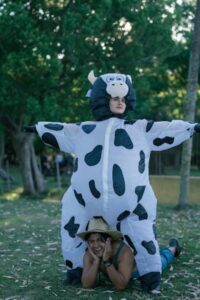
(Photo by Guillermo Berlin on pexels.com)