Migration: Characters on the Move

Dear Kids and All Readers,

Here comes March! It is a month in motion.

Birds take flight on long journeys, chasing the sun. In the Northern Hemisphere, nests are built. Animals emerge from winter slumber. Even the weather seems to migrate—drifting from cold to warm and back again in a single afternoon. (Though here in Southern California, it’s not as noticeable!) But wherever life exists on Earth, March brings a season of shifting, stretching, and stepping into new beginnings.

As an author, I can’t help noticing how much this mirrors the way characters move through stories. Whether you’re nine or ninety, every great story begins with someone who decides—willingly or not—to go somewhere new. And this is certainly true in my mystery books as each case immerses the detectives in new clues, risks, and rewards. As the plot progresses, the characters must change as they face challenges and, hopefully, learn from them. My detectives will not be the same when the case wraps as they were when it started. Few memorable characters are. So, . . .

Migration isn’t just about travel. It’s about transformation. It can make stories and characters reveal their humanity, come alive, blossom, and thrive!

  • A character leaves home and discovers who they really are.
  • A creature follows an ancient path and finds unexpected challenges.
  • A hero takes one brave step and ends up somewhere they never imagined.
  • A character learns valuable lessons about the importance of truth and trust.

I chose to shine a brighter spotlight on character migration (travel and growth) in Bougainvillea Street: Stolen Tiara, Book 8 in The Botanic Hill Detectives Mysteries, releasing in September 2026. My goals were, first, travel: to bring my detectives back home to California after solving their last five cases out of town! Second, transformation: to show young readers the importance of rising above discouraging times, staying sharp and positive, despite clues fizzling or someone disappointing us in our life migrations. To achieve this, I lobbed many serious roadblocks and curveballs at my sleuths. Did they rise to each challenge, or collapse in frustration? Or both? Did they grow or remain the same? What triggered any transformations?

Kids instinctively understand personal migration, I believe, because they’re in their growing years. Adults sometimes forget it. But we’re all migrating in our own ways—growing, learning, and shifting into new seasons of life.

So, get a clue, Readers. Here’s a peek into my Writing Nest: I often find my detectives itching to move. Faithful readers might recall that each of my mysteries ends with the detectives yearning for a new case because they crave adventure. They must be on the move!

Movement gives them purpose. It gives me purpose, too. When a character starts migrating—emotionally or literally—I know the story is about to take flight.

Call to Action!

I’d love to hear from you this month. Tell me:

  • What kind of migration is your favorite character experiencing?
  • What kind of migration story would you like to read?
  • What migration are you going through?

Hit reply and let me know. March is a season of movement, and I’d be honored to walk—or fly, or swim, or gallop—through it with you!


To my Fiery Muse: Ole!

Hello, Kids, and All Readers,

As I write this, I’m finishing a bowl of my neighbor’s delicious vegetarian pozole rojo, garnished with avocado and crispy corn tortilla strips, while listening to Andres Segovia play Joaquin Rodrigo‘s Concierto de Arnajuez. It’s arguably the most famous guitar concerto ever composed. For me, the piece is a gorgeous Spanish landscape, evoking Moorish images and Flamenco rhythms.

This isn’t the first Spanish classical guitar music I’ve heard lately. In fact, I’ve been vibing to all things Latin, like the paintings of  Goya and Velazquez, Francisco Tarrega’s and Angel Romero‘s virtuoso guitar music, Herb Alpert and the Tijuana Brass (can’t get enough of  “The Lonely Bull”), Ernesto Lecuona‘s peppery piano piece Malaguena, movies with pianist Jose Iturbi (Holiday in Mexico), Antonio Banderas (The Mask of Zorro)Ricardo Montalban (Latin Lovers), and TV with Henry Darrow as Manolito Montoya in The High Chaparral.

Not to omit literature, I’ve read Johnston McCulley‘s Zorro adventures. A friend has recommended Isabel Allende‘s Zorro for a tidy culmination. And where is my college copy of Miguel de Cervantes‘s Don Quixote?

Throughout this artistic Latin immersion, I’ve been appreciating how our Latino immigrants have enriched my life, not the least of which is via their hard work and fabulous Mexican food. Both prevail here in San Diego, California! Do I smell chips and salsa??? Is that a mariachi band playing in Old Town’s Casa de Reyes RestauranteOle!

This Muse, the wonderful artistic and culinary celebrations, took hold shortly after I started writing my Book 8, Bougainvillea Street: Stolen Tiara, set to launch in late September 2026. The historical aspect harks to the early Californio days (1769 – 1848) when Spain and later, Mexico, owned the land that I and nearly forty million other people of diverse ethnicities call home.

But my Muse also struck before I started writing! So, at this point, halfway through writing the book, I think it is fair to say that the book and the artistic celebrations are now equally inspiring each other. That’s the beauty of my Fiery Muse. Ole!

So, get a clue, readers. What inspires you to create? Does your Muse take over your life as mine has? Where has your Muse led you? For me, it’s a delightful journey. And I sense that Bad Bunny is next on my Spotify playlist. Ole!


(Image Credits: Portrait of Dona Isabel Cobos de Porcel (c. 1805) by Francisco de Goya; Mexican food plate. Both from commons.wikimedia.org; in the public domain. Classical guitar photo by Vladimir Petrovic on pexels.com)


Reindeer by Any Other Names . . .

Hello, Kids, and All Readers,

Can you name all eight of Santa’s reindeer–not counting Rudolph, who is the ninth?

Go ahead. I’ll wait. . . .

If you’re grinning because you remembered them, did you rely on the 1949 song “Rudolph, the Red-Nosed Reindeer” with the verses, “You know Dasher and Dancer, and Prancer and Vixen; Comet and Cupid, and Donner and Blitzen …”? I always do!

Now, check your response against the famous 1823 poem that added the eight reindeer (no Rudolph yet) to Team Santa, “A Visit from Saint Nicholas”–now more commonly known as “The Night Before Christmas”: “Now Dasher! now, Dancer! now, Prancer and Vixen! On, Comet! on, Cupid! on, Dunder and Blixem! To the top of the porch! to the top of the wall! Now, dash away! dash away! dash away all!”

Wait. Donner and Blitzen are missing! Or perhaps their names are misspelled?

Neither, really. Donner and Blitzen were originally Dunder and Blixem! Why, you ask? Ah, that’s our literary mystery!

According to snopes.com, the story of how the two reindeer names changed “is a complicated and confusing one [since much] mystery remains about the origins of the poem ‘A Visit from Saint Nicholas’ that named them.”

Clement Clarke Moore, a Bible professor at New York’s General Theological Seminary who knew German, was believed to have written it in 1823. An 1836 reprint of “A Visit from Saint Nicholas” credited him. Moore included it in a volume of his own poetry, published in 1844. But rumors persist to this day that “A Visit from Saint Nicholas” was written by a New Yorker of Dutch descent named Henry Livingston. Can you put the following potential clues together to draw your own conclusion?

Whichever man wrote it in 1823, he “melded elements of Scandinavian mythology with the emerging Dutch-American version of Santa Claus as a jolly, pipe-smoking fellow and produced a vision of a sleigh pulled by eight flying reindeer. He assigned names to all eight, and he took two of them from a common Dutch exclamation of the time, ‘Dunder and Blixem!’–the Dutch words for thunder and lightning–as the names appeared in the original 1823 publication of ‘A Visit from Saint Nicholas.'”

In 1837, publisher Charles Fenno Hoffman printed a version of “A Visit from Saint Nicholas” that included his changes of Blixem to Blixen (to make it rhyme with Vixen) and Dunder to Donder (perhaps to bring the spelling more in line with English pronunciation).

When Moore prepared to publish “A Visit from Saint Nicholas” in his own 1844 book of verse, he changed the Hoffman/corrupted-Dutch term Blixen to the German term Blitzen, but oddly retained Hoffman’s term Donder. Earlier generations of children learned Santa’s two reindeer as Donder and Blitzen due to Moore’s 1844 poem version.

Wait. Wait. So, when did Donder become Donner?

Donner and Blitzen are German words forthunder” and “lightning.” So, if Moore were familiar with German, why would he have used Blitzen but not Donner, instead of the Dutch Dunder (in the 1823 version) or Donder (in the 1837 version)?

Precisely how and when Donder made the transition to Donner remains a mystery! The earliest mention of Donner, not Donder, occurred in The New York Times 1906 newspaper publication of the poem. In 1926, the same paper stated that “modern publishers rechristened two of the reindeer with the German names ‘Donner and Blitzen.'” But hold it! We know that Moore used Blitzen in 1844. As Charlie Brown would scream, “Aaugh!”

But now, dear Readers, “Dash away, dash away, dash away all!” and enjoy your holiday season. Our four Botanic Hill detectives and I wish each of you Happy Holidays!

(Photo Credit: Soc Nang Dong on pexels.com)

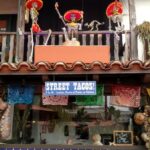
Dia de los Muertos–Day of the Dead

Hello, Kids, and All Readers,

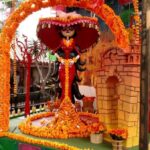
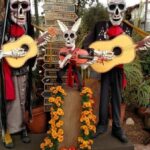
I consider myself lucky to live in Southern California, where Dia de los Muertos, the Day of the Dead, is celebrated every November 1 and 2. The first day honors deceased children; the second day, deceased adults.

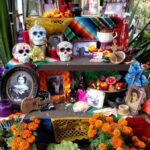
It is a fiesta that can trace its roots to Mesoamerica, specifically to the Aztecs. Their ancient tradition of honoring deceased loved ones by welcoming their spirits back to Earth temporarily has been carried forward by many Latin-American countries and their Indigenous peoples. It is estimated that ninety-one per cent of all Mexicans celebrate it! Traditions can include family gatherings, processions to cemeteries to clean and decorate graves, prayers, sharing photos and fond memories of lost loved ones, building memorial ofrendas, or altars with mementos and food offerings, to the deceased, escorting their souls home for a visit, ritual food preparation, festive meals, music, and dancing. Food includes tamales and dishes favored by the deceased, Mexican hot chocolate, and orange- and cinnamon-spiced bread called Pane de Muertos with Aztec symbolism.

Another tradition is public parading while wearing skull masks or face paint to resemble skulls. It is believed that the masks and images hark to Mictecacihuatl, a skull-faced Aztec goddess, who guards the dead. Calaveras, or skulls that represent the deceased, take form in costumes for all, and toys and sugar or chocolate candies for the kids. La Catrina, a female skeleton wearing an elaborate floral hat, was created by the artist Jose Posada in the late nineteenth century, and has become synonymous with Dia de los Muertos.

According to the publication 1440, “Some historians assert that when European colonizers attempted to wipe out Indigenous religious traditions, Mictecacihuatl’s festival merged with Catholicism to become the modern Day of the Dead. Other scholars suggest the exact opposite—that in the early 20th century, the indigenismo movement, which aligned Mexican identity with their Indigenous ancestors rather than Spanish colonizers, wanted to encourage national pride by retrofitting All Saints Day, a Catholic [November 1] holiday, to include variations of Aztec traditions.” But never conflate Dia de los Muertos with Halloween! Do you know why?

One of my most memorable visits to Old Town, where my hometown of San Diego was founded in 1769, was to view the ofrendas erected to honor local deceased residents. The love for those lost was palpable–and joyful–with photos, mementos, marigold flowers, and food displays. It is believed that marigolds help the souls find their way home.

So, get a clue, Readers. Dia de los Muertos can be a happy and sad occasion. I so appreciate and respect how loved ones gather to embrace those still grieving, helping them sense the souls of the departed nearby, sharing fond memories, and turning mourning into a fiesta. It honors not only the dead, but also the living.

(Photos by the author)

Unearthing Terror: Taphephobia!

Dear Adult Readers–Be Forewarned!

This news blog post may be too scary for some children or inappropriate for anyone dealing with the death of a loved one. Otherwise, in my opinion, it is perfect for Halloween! Read at your own risk or pleasure, depending on your circumstances, and preferably by candlelight or the glow of a jack-o’-lantern.

“It may be asserted, without hesitation, that no event is so terribly well adapted to inspire the supremeness of bodily and of mental distress, as is burial before death . . .  that our hopeless portion is that of the really dead — these considerations, I say, carry into the heart, which still palpitates, a degree of appalling and intolerable horror from which the most daring imagination must recoil.”  –excerpted from “The Premature Burial,” by Edgar Allan Poe (1809 – 1849).

In “The Premature Burial” (1844), one of my favorite Poe short stories, the Master of the Macabre takes up the topic of taphephobia (taff-uh-FO-be-uh): the fear of being buried alive! I will spare you the gruesome details, examples, and potential sepulcher escapes he so cleverly devised for his story. Because on Halloween night, between trips to the door to pass out candy for warding off evil spirits, you might want to read the story for yourselves HERE.

In addition, you can watch on Tubi for free Roger Corman‘s atmospheric 1962 companion film (1 hour, 20 minutes), starring Hollywood’s Ray Milland and England’s Hazel Court, HERE. And Boris Karloff’s 1961 dramatic Thriller adaptation of Poe’s story HERE. Caution: Both are spooky!

And if you read this post before October 28, I hope you will sign up HERE to join Poe fans, including me, for “Poe Unplugged: ‘The Premature Burial.'” That evening, we will discuss via Zoom Poe’s story, hosted by The Six Degrees of Poe bloggers, Carmen Bouldin and Jeanie Smith. The terrifying fun begins at 5:00 pm, PT.

Taphephobia (sometimes spelled taphophobia) comes from the Greek taphe and taphos, meaning burial, grave, tomb; and from the Latin phobia, meaning fear.

We see the root in words like epitaph (an inscription on a tomb), cenotaph (a tomb or a monument erected in honor of a person whose body is elsewhere), and bibliotaph (one who hides away or hoards books–I might represent that term).

Perhaps as no surprise to most, Poe was taphephobic. Check out scholar Ed Simon’s brilliant LitHub article from October 8, 2025: “To Haunt and Be Haunted: On the Exhumation of Edgar Allan Poe.” Simon graphically explores, sense by sense, awakening in terror six-feet-under, then in connection with Poe’s works. It is not for the faint of heart.

We know that Poe was not inhumed alive following his death in 1849. But in 1875, when his remains were exhumed for reburial in a more dignified resting place, careless gravediggers dropped his deteriorated wooden coffin. It splintered apart, which contributed to the “dark rumor” that he must have attempted to claw his way out after a premature burial! All rumors.



Indeed, taphephobia gripped many in the nineteenth century, especially the cataleptic, who only appeared to be dead, and before the practice of embalming prevailed. Two of Poe’s contemporaries, first, composer Frederic Chopin (1810 – 1849) requested that his heart be cut out once he was pronounced dead, not just so it could be buried in his native Poland, but to ensure he had truly died pre-burial; and second, Russian writer Nikolai Gogol (1809 – 1852), specified in his will that he “not be buried until his body showed visible signs of putrefaction.” Such Will additions did occur. Hold your nose!

Underscoring this is another article with some incredible facts, dated October 29, 2025, by Christopher Klein, “Buried Alive: Inside the 19th-Century Panic over Premature Burial,” from Inside History.

Little wonder, then, that the taphephobic Poe took up the theme in some of his other works, too, such as “Berenice” (1835), “The Fall of the House of Usher” (1839), “The Tell-Tale Heart” (1843), and “The Cask of Amontillado” (1846). Poe wrote, “The boundaries which divide Life and Death are at best shadowy and vague. Who can say where the one ends, and where the other begins?” Echoes of taphephobia.

And it so happens that a premature burial occurs (though 300 years ago) in my Book 7, Macadamia Street: Hidden Skeleton. But it is still a kid-friendly, present-day pirate story. I promise.

So, Readers, get another morbid clue. If as Ed Simon states in his article above, “Fundamentally, taphephobia concerns the stubborn endurance of that which we thought we’d buried . . . ghost stories about being haunted and being the haunting,” I say, let’s hear it for cremation. Happy Halloween to those who celebrate!

(Image Credits: Top–Mojo_Maniac; Bottom–in the public domain free Wiki Images, both from pixabay.com)

Pumpkins

Hello, Kids, and all Readers,

We see them everywhere in the Northern Hemisphere right now–from farms to grocery stores, garden shops, front porches, ovens, and Starbucks.

Presenting autumn’s icon, the ubiquitous Pumpkin!

Did you know that the word “pumpkin” came from the Greek pepon, meaning “large melon”? The French called it pompon, and the English of yore pumpion. Colonial North Americans called it pumpkin. A member of the gourd family, the pumpkin predates beans and corn, having been cultivated by Indigenous peoples in North America over seven thousand years ago. Depending on the tribe, they called pumpkins isqoutm, askutasquash, deohako, and other names.

But my favorite pumpkin details revolve around the squash’s symbolism, folklore, appearances in literature, and on Halloween:

In many worldwide cultures, pumpkins represent abundance, prosperity, and rewards of labor–especially during harvests. Pumpkins are often symbols of growth, change or transformation, and renewal. (Think Cinderella’s pumpkin coach.)

In 2015, Barnes and Noble published “The Six Most Famous Pumpkins in Literature (and One Rutabaga)”, by Diana Biller. Click on that title to find Biller’s choices. But here are author clues:  Perrault, Washington Irving, L. Frank Baum, Arthur Golden, Nathaniel Hawthorne, and Charles Schultz. Can you name the respective pumpkin literature before viewing the article?

You rightfully ask, “So, how did a rutabaga come to be associated with the pumpkin?” From the Legend of Stingy Jack. Centuries ago in Ireland, the first Jack-o’-lanterns were turnips carved with frightening faces to scare off evil spirits. (Some confuse turnips and rutabagas.) Legend has it that a deceitful trickster blacksmith named Stingy Jack tried to fool the Devil many times. His punishment was to roam the Earth in darkness for eternity. He carved and carried a turnip to light his way, aglow from an ever-burning ember. Enter Jack of the Lantern. Jack-o’-Lantern! And that brings us to Halloween.

When the Irish emigrated to North America in 1846 to escape the Great Famine, they discovered that pumpkins were easier to carve than turnips. Viola! The modern-day pumpkin jack-o’-lantern was born and still adorns many porches and windows on Halloween to warn off evil spirits like Trickster Jack. This also explains why kids go door to door and say, “Trick or treat!”

So, get another clue, Readers. It isn’t too soon to start thinking about how you will carve your jack-o’-lantern’s face this year. Salute the Irish and the marvelous pumpkin for keeping us safe from the goblins on Halloween night!

(Photo credits, left to right: Ylanite Koppens, Matheus Bertelli, Aleksandar Cvetanovic, and Sarah O’Shea, all from pexels.com)